
A Creative Project with Three Mayo Schools
Composing new songs to tell the story of Ireland’s famous “Pirate Queen” – Gráinne Mhaol, Grace ‘O Malley.
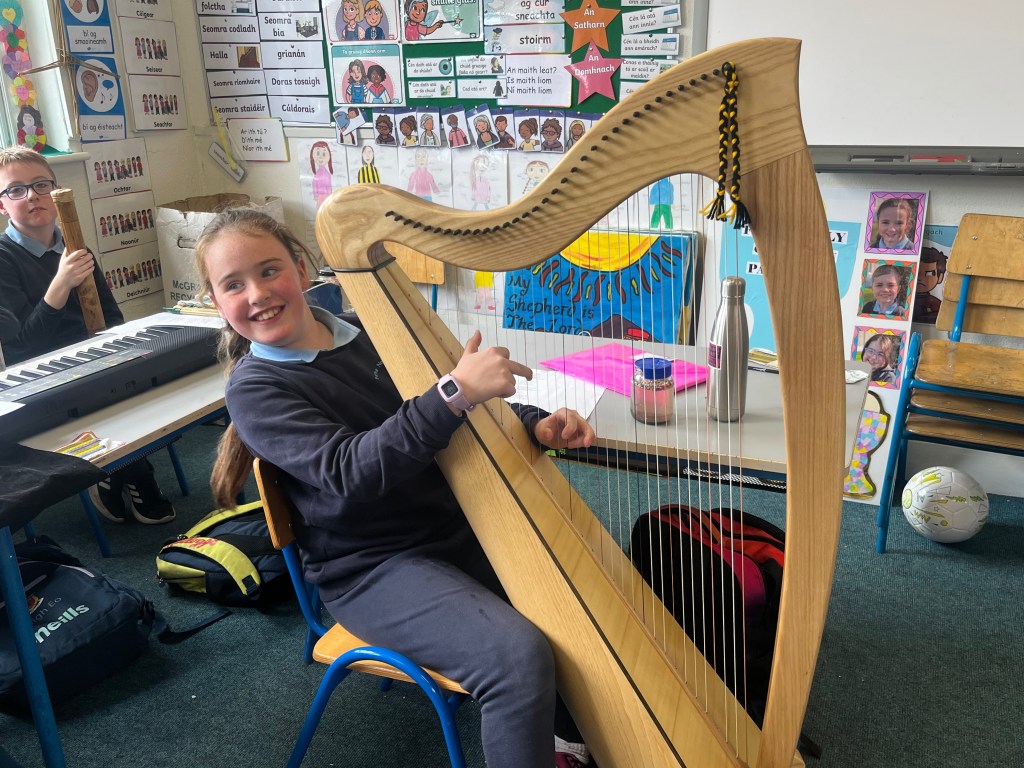
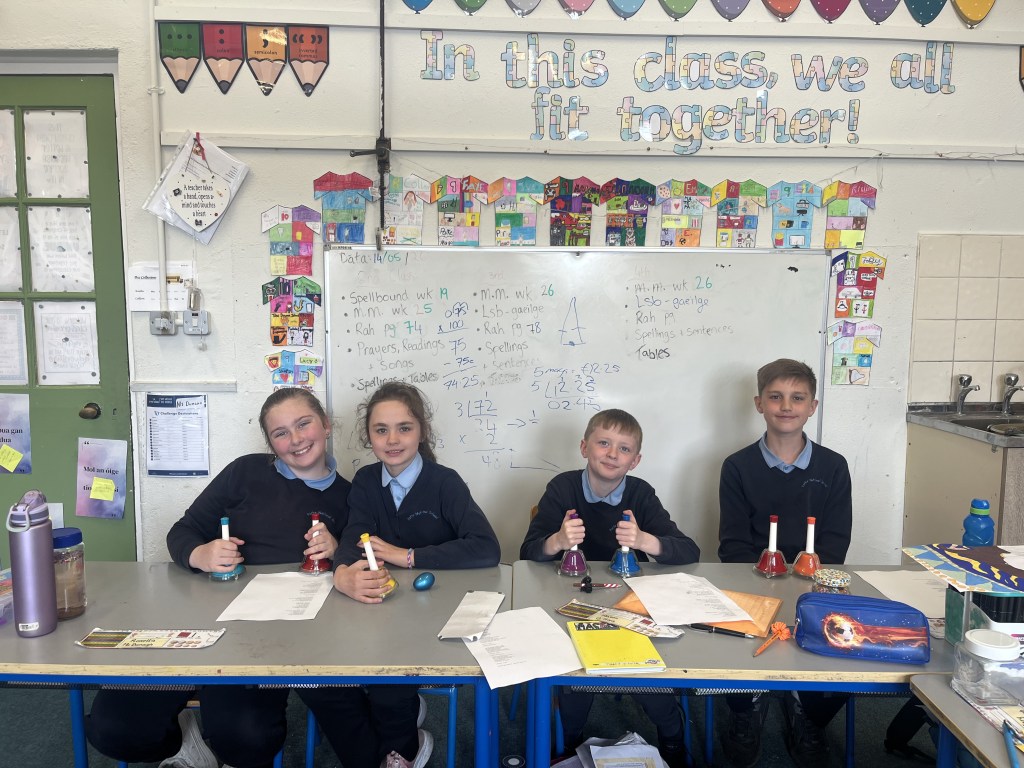
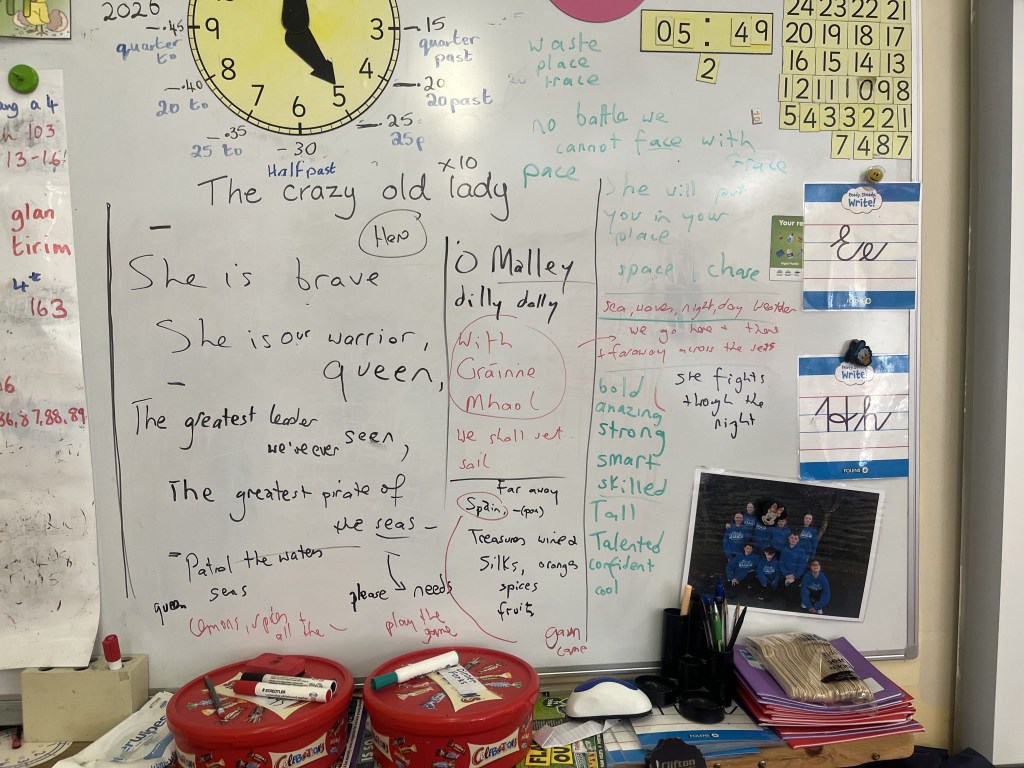
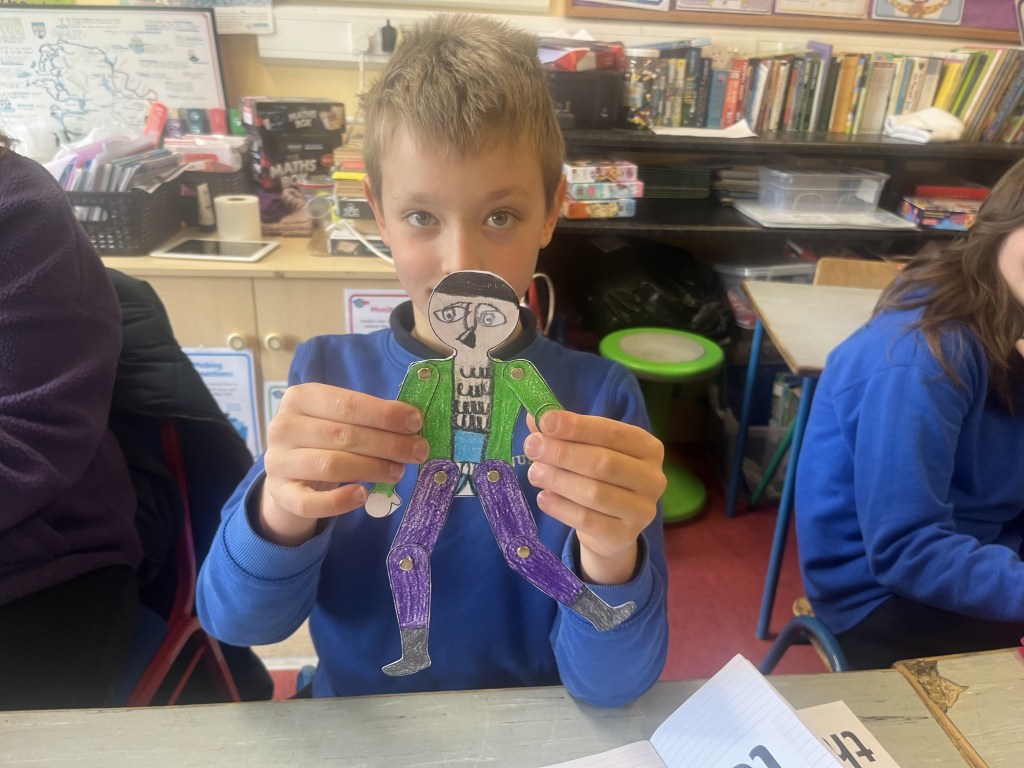
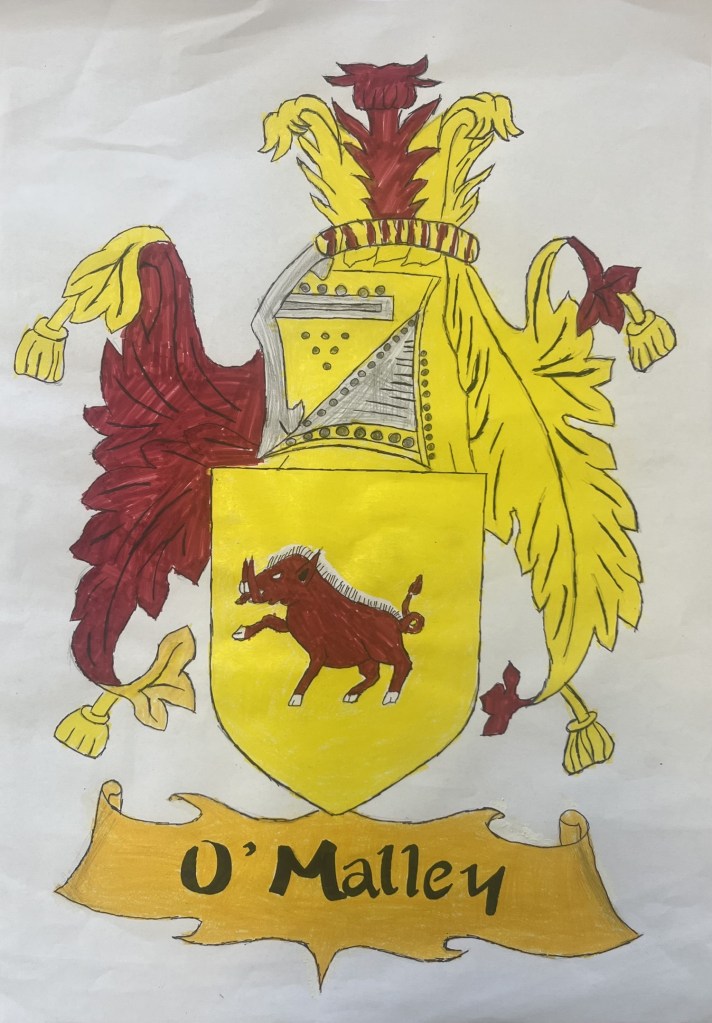
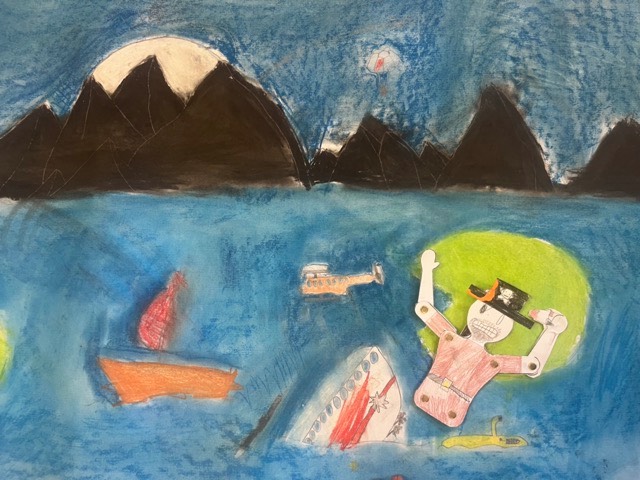
“Granuaile, Gráinne Mhaol, Grace ‘O Malley, Gráinne Ní Mhaille…“
Origins of the Project and Overview
This project was co-ordinated by Amy King of Ballyvarry Central National School with support from Carmel Balfe. Having seen work I had done on the “Children of Lir” project with Castlebar Primary school, Amy reached out to me to work on this Creative Clusters iniative. I was invited to work with a class at three primary schools of Ballyvarry, Manulla and Parke on a project to engage creatively with the story of Gráinne Mhaol, the famous and notorious Irish captain and ‘pirate queen’ who sailed the coasts of Mayo in the 16th century.
I was excited about this project for the many themes it offered, life on the ocean, the Gaelic way of life, the heroism, resilience, bravery, courage and tenacity that Gráinne Grace ‘O Malley is remembered for. Especially with regard to the role and position of women in society, Gráinne Ní Mhaille was exceptional not only as a female chieftain, mother, merchant, an excellent mariner and sailor, she was also a communicator who had a command of Latin, Spanish as well as native Irish language. Her name is immortalised on a famous 16th century map commissioned by Queen Elizabeth where she is acknowledged as the chieftain of the area.
It seems that much of the story of Gráinne Ní Mháille was written out of history but for the work of author and historian Anne Chambers. Anne’s erudite books served as a great resource and reference for this project. As part of exploring the story of Gráinne, Grace ‘O Malley, I shared images of the letters that had been sent to Queen Elizabeth, the ‘O Malley family crest, the many castles that were at Gráinne’s command along the Mayo coast. From Clew Bay, Grace O Malley was known to have travelled to Spain, to Scotland and also directly to meet Queen Elizabeth in 1594, sailing her galley ship up the river Thames. She is reported to have rejected Queen Elizabeth’s offer of a title of countess, claiming that she was already royalty.
In Ireland of past centuries, it was clearly common for women to serve as leaders. St. Brigit was recently recognised with a bank holiday yet Brigit was just one of many female leaders – we also have St. Attracta & St. Dearbhaile in Co. Mayo alone. It is known that these were real women, serving in their communities who are remembered for the churches they founded, and the wells that bear their names. In Gráinne, we have an exceptional female figure who broke the mould, she was a cosmopolitan woman who travelled the world and literally captained her own ship! As a chieftain, merchant and skilled mariner, Gráinne Mhaol maintained a network of allies and admirers. By choice and by necessity, she lived an adventurous and daring life at a time when few women occupied such positions of leadership and power. The ‘O Malley chieftains were responsible for the founding of Murrisk Abbey, and other churches of the region. Gráinne’s burial place is on Clare Island, the place she spent her youth looking out upon the ocean and the vast world beyond. Her father was the powerful Eóghan Dubhdara Ó Máille.
During her lifetime, Gráinne witnessed the oppression and acquisition of Mayo lands by England’s agent in the west Bingham who also killed her oldest son. It was following Bingham’s merciless razing of the lands of north mayo, killing all women and children and stealing all the cattle and horses that had been in her position, that Gráinne decided to sail to London to appeal directly to Queen Elizabeth herself. Two women, both the same age, around 64, at a time when pirates such as she was were being hanged. Already, Gráinne Ní Mháille, Gráinne Mhaol had been locked in a tower at the behest of Mayo’s governor Bingham. She only narrowly escaped with her life.
Grace ‘O Malley also gives insight into a time in Ireland’s history where the infighting and pettiness among divided clans contributed to the strife. Elizabeth’s plantation in Munster involved the dissolution of the Desmond dynasty where thousands of hectares of land, once in the possession of Ireland’s nobility, were parcelled out to English gentry as favours, to queen Elizabeths favourites such as Walter Raleigh & Edmund Spencer. A story is told of the former queen of the Desmond territory who was reduced to begging on the streets of Dublin, alienated and relieved from her former life of privilege and splendour.
As part of the research for this project, I visited Beleek Castle where the museum there houses the bed of Gráinne Mhaol, an actual four poster bed, bought by Dolan from Westport House. The Browne family are indeed descendants of Grace ‘O Malley and she is known to have slept in that bed. The military museum shows the variety of armour and weaponry that may have been employed during the time of Gráinne Ní Mháille Gráinne Mhaol.
Grace ‘O Malley’s castles along the Mayo coastline include:
Carraig-an Chabhlaigh or Rockfleet Castle ( still standing )
Belclare Castle in Clew Bay ( no longer present )
Clare Island Fortress – open to the public
Caisle an Ghráinne – Kildavnet Castle on Achill Island
I am grateful to the scholarship of Anne Chambers who wrote an excellent book about the life of Gráinne Mhaol. I would encourage you to seek it out if you are inspired to learn more about this fascinating Mayo woman.
Below each of the embedded videos below ( which are currently ‘unlisted’ on YouTube) you will find downloadable MP3 recordings of the songs composed by each group as part of this Creative Clusters Project.
MANULLA NATIONAL SCHOOL
Teachers: Claire Brennan, Nolla Gibbons
This song captures the spirit of Gráinne’s crew and her journeys across the waves, a visit to Spain, a sense of adventure and being close to nature and the ocean.
It felt important to start with drama and expansive creative exploration with this class of diverse abilities where there seemed to be a strong divide between the boys and the girls. We began with imagining what life was like as a navigator, where there was no internet, and no mobile phones. How Grace O Malley woudl have had to be skilled in reading the stars and the weather. As the weeks progressed it became clear that this was the crew of Grace ‘O Malley’s galley and that the song would be from their perspective. The first part of the recorded song was composed with the Teacher Claire Brennan as a call and response. Then we further explored this perspective telling the story of a journey from the point of view of one of her pirate crew.
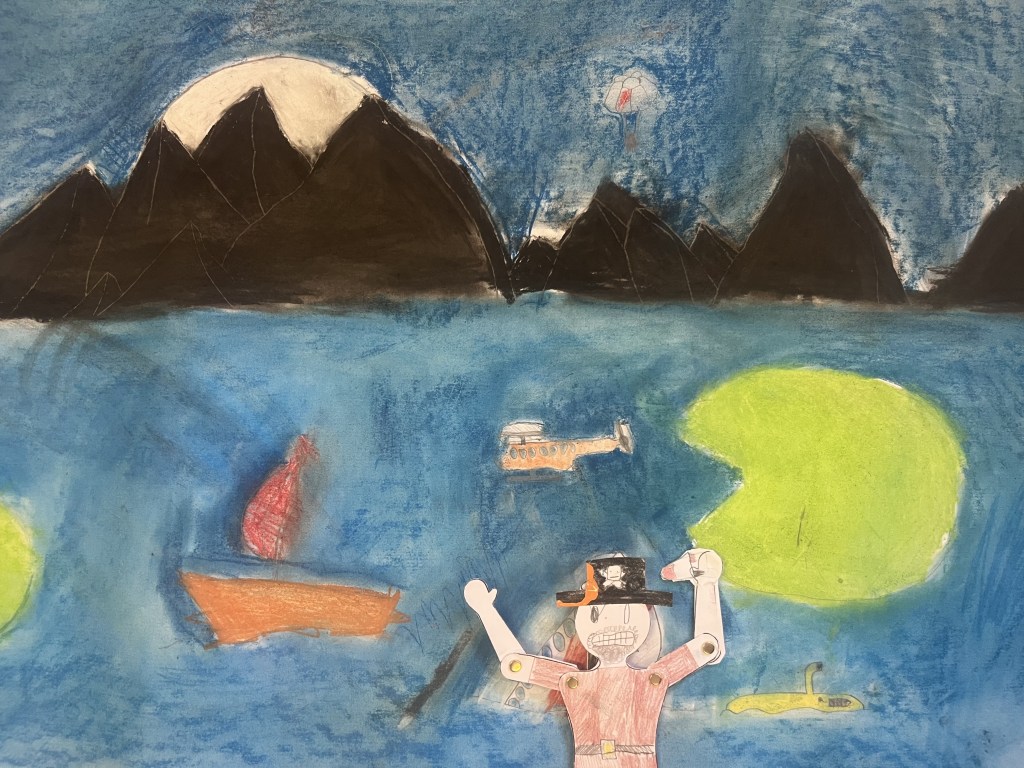
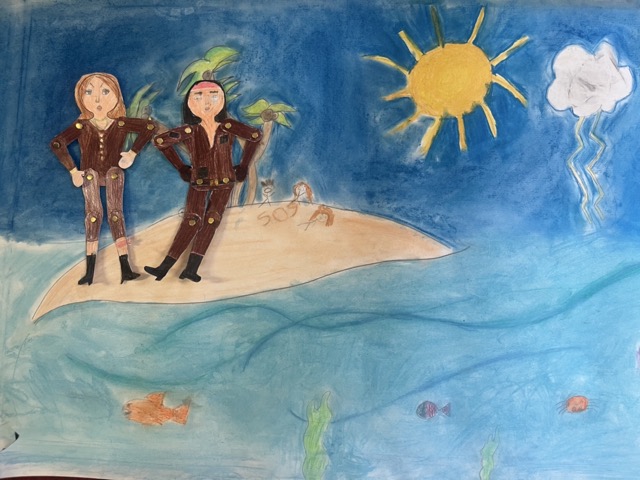
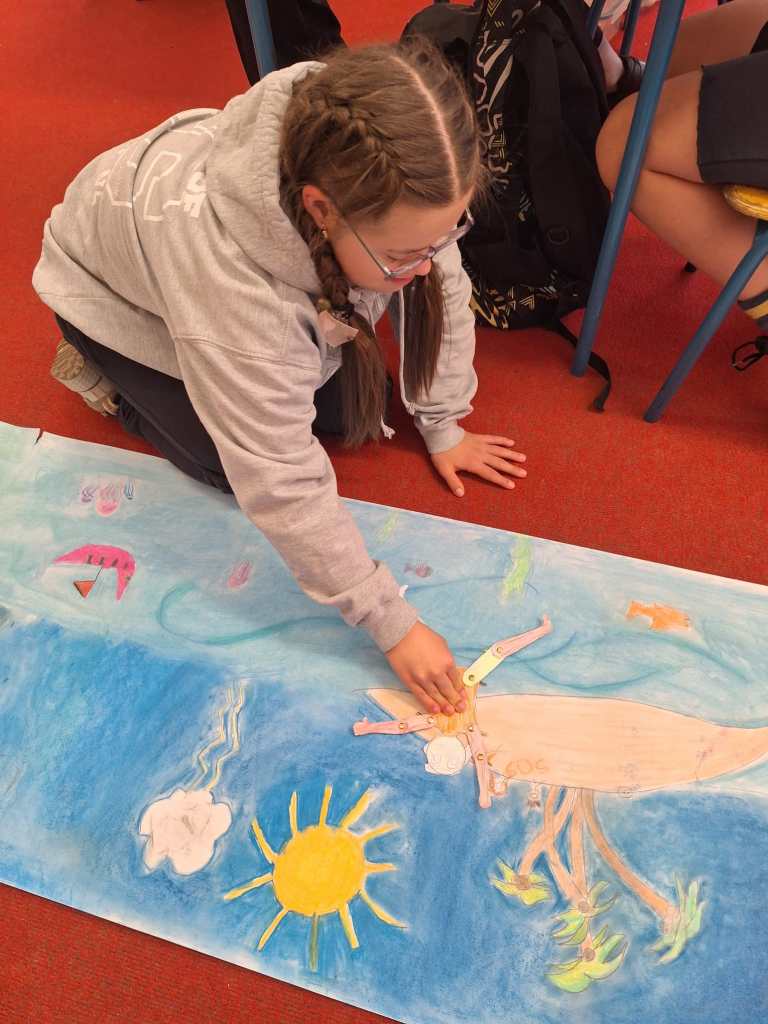
In the final week the children created pirates which they placed on the backdrop image that they had already created together. I photographed these inviting them to move their pirate ‘puppet’ in small ways – and these photographs then became part of the final video that you see for the song. As we were preparing to perform and record the song in our last session, I shared some drama games with the children to help them to access their confidence and stronger voices.
Through the course of this project the children explored large scale painting and drawing to create a sea scape for Gráinne’s travel. We also explored simple African rhythms evoking that often repeated tale of how Gráinne’s ships were often attacked by Algerian pirates. One of the stories that has been passed down to us tells of how Gráinne Mhaol saved her own father when their ship was being attacked by these Algerian pirates. Therefore, we divided the class in two groups and explored that tension of the ship being attacked and the skill and courage required during those dangerous times at sea.
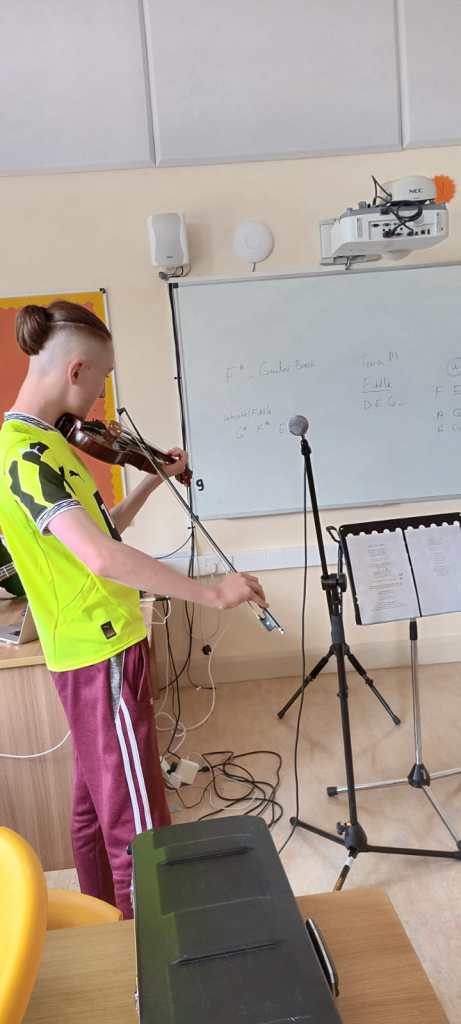
In preparing to record the song, we added instruments and percussion. It was clear that the class were quite experienced and comfortable playing the tinwhistle and so we included a melody that they played as a group. The class practiced this during sessions so that they were very strong when it came to recording together in the final weeks.
I hope that the class will always remember the courage and bravery that is encapsulated in their song as a fierce crew with their captain Gráinne Mhaol.
PARKE NATIONAL SCHOOL
The song composed with Parke National School is titled “Saoirse gan daoirse”. The lyrics evoke a sense of freedom and soulful connection with the sea as well as the struggles of Gráinne’s tumultuous life.
Teacher: Samantha Duncan
I was delighted to work with this class group of second, third, fourth and fifth class with their teacher Ms. Duncan. The children showed bright interest in the project from the start.
For the opening sessions I began with drama exploring imagination and storytelling and seeing how the children could work together sharing mimed performance that they devised themselves in small groups. As this was a small class, it was wonderful engagement and participation with all of the children involved.
Given the age and atmosphere in the class our focus in approaching the tone of the song evolved to be expansive and emotional. Together with their teacher, the children decided on a theme of
As the weeks progressed, we developed a song together each week adding another verse and going deeper into the theme. The title, ‘Saoirse gan Daoirse’ is taken from the stirring chorus.
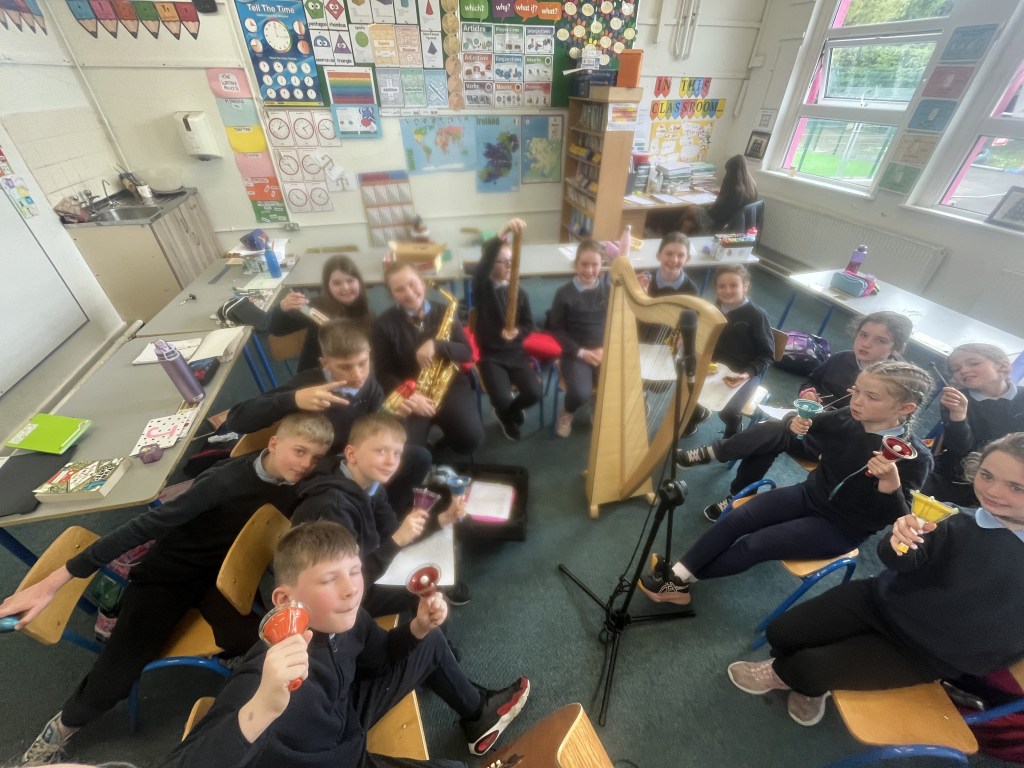
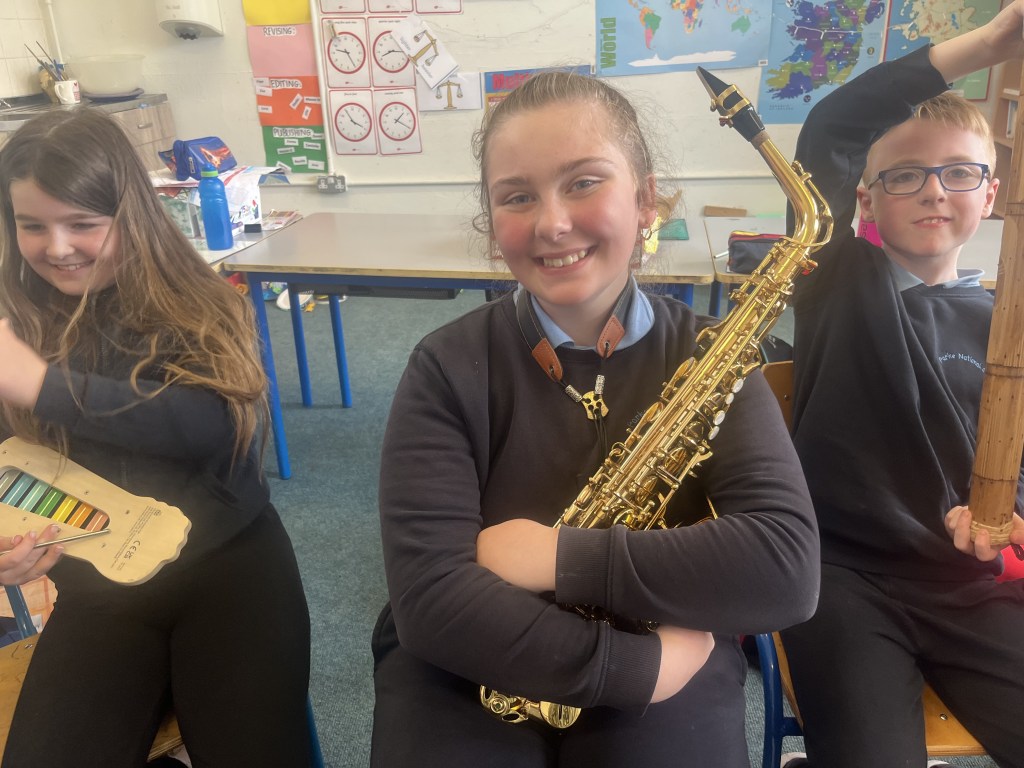
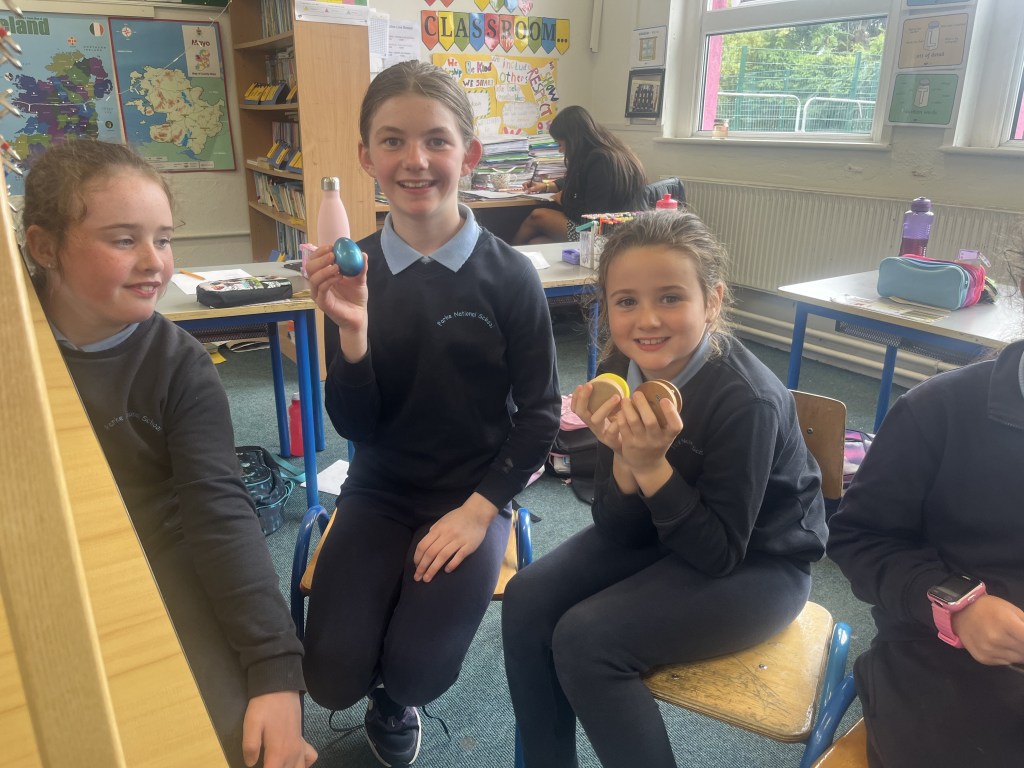
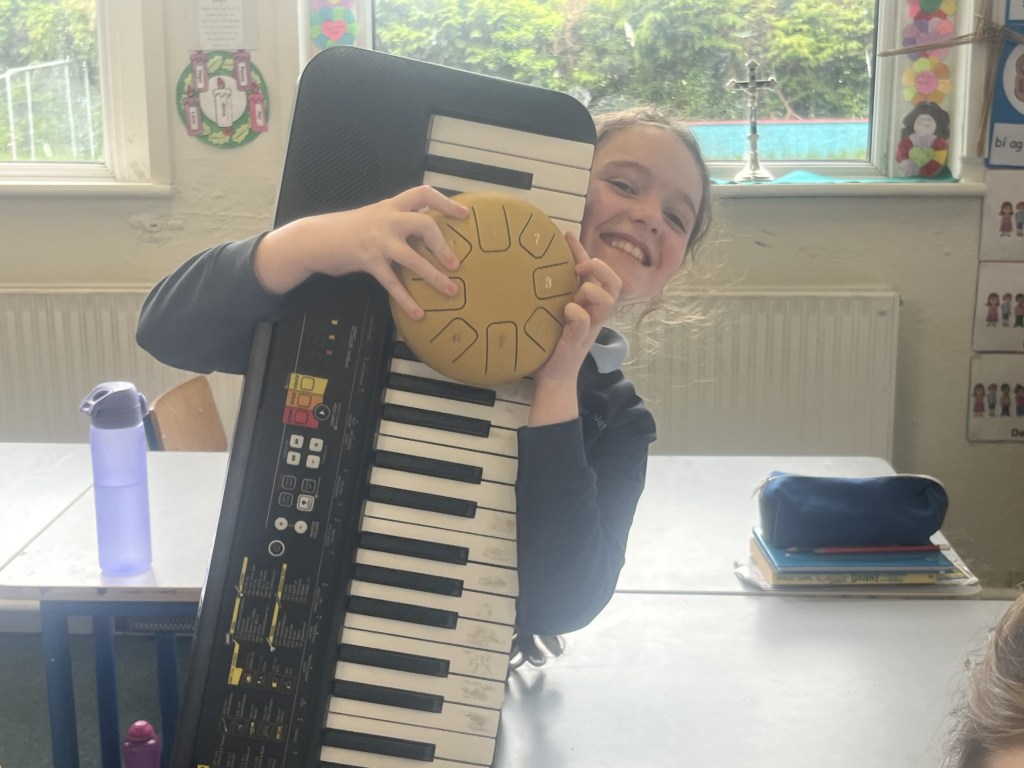
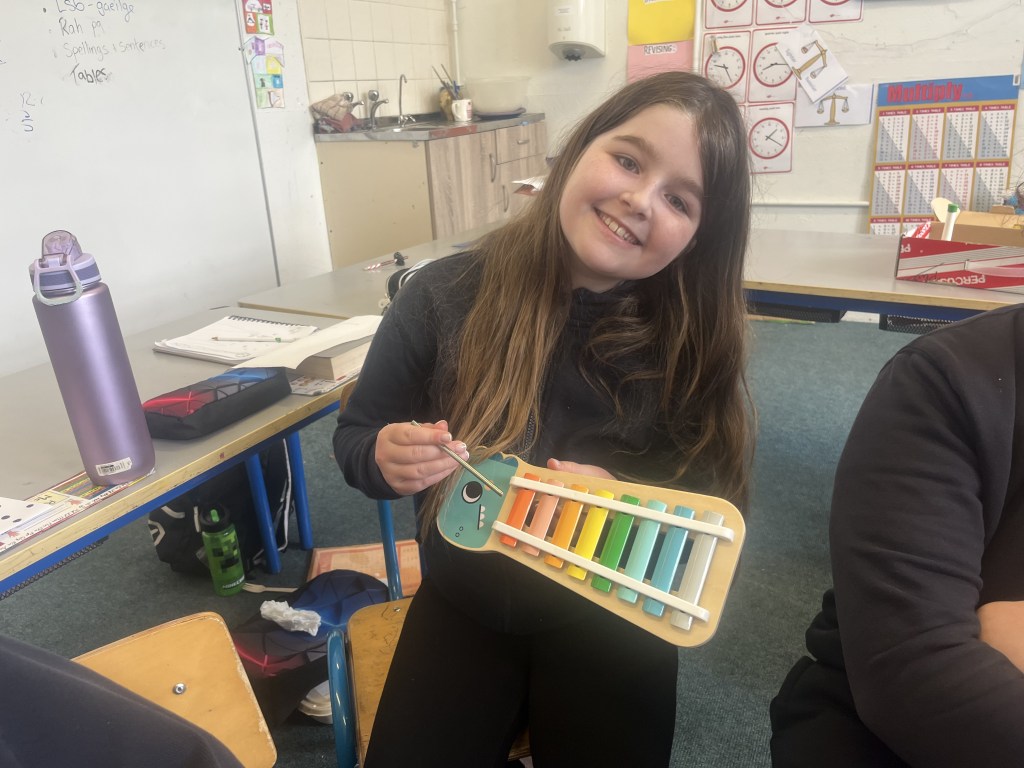
As the children knew the words well, as there are some excellent musicians in the class, we brought in the percussion and instruments to add to the storytelling of the piece. Together with the children we worked on the arrangement, adding a rain stick and bell pattern, also a tongue drum ( the xylophone like percussion metal ) and keyboard, harp and saxophone.
There were also wonderful contributions from the shakers, triangle and xylophone. The children enjoyed practicing the song over the final weeks, working on timing and becoming strong in their singing so that the words are clear.
The character of Gráinne Mhaol really comes through in this song which is written from her own imagined perspective. We imagined Grace as a younger woman who spent so much of her time on the sea and how that felt. The song explores Gráinne Mhaol’s essential relationship and love for the sea. It is true that she would always return to the ocean to seek refuge when times were rough on land ( which they often were in those tumultuous times).
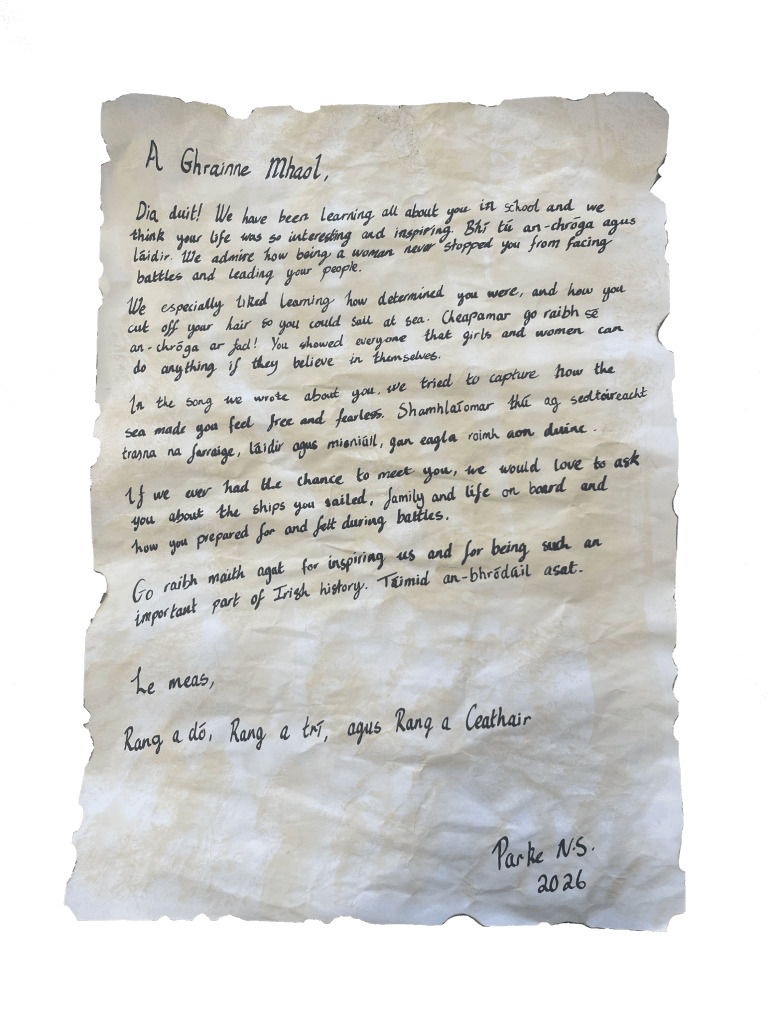
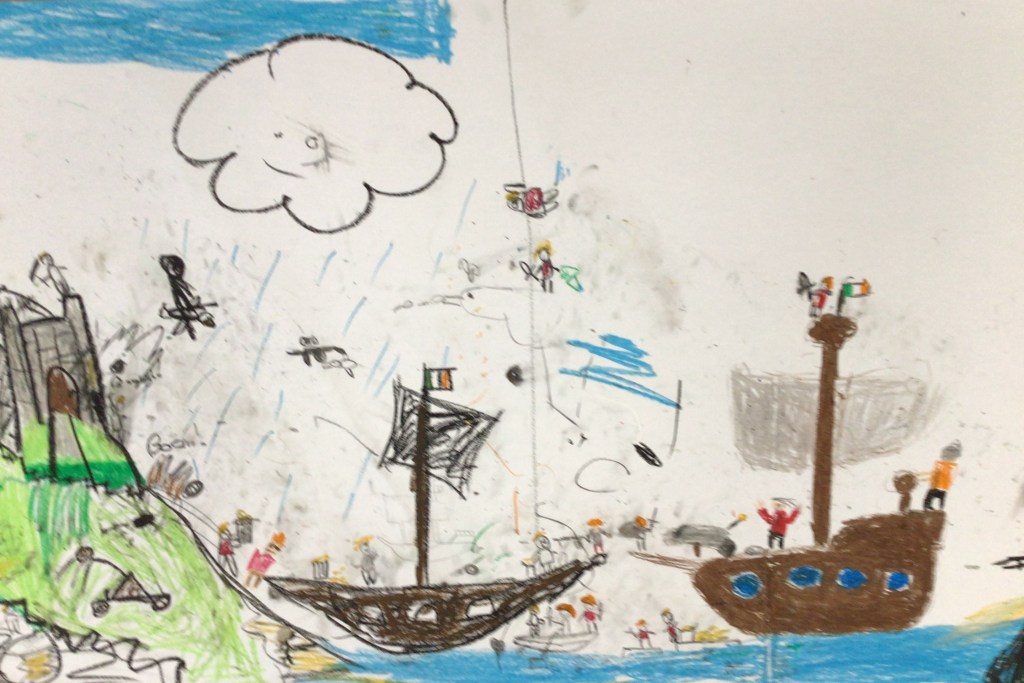
The children chose to respond to the story of Gráinne Mhaol in their own way, illustrating the words of the song with creative ideas. I also invited the class to collaborate with their teacher on a letter to Grace ‘O Malley.
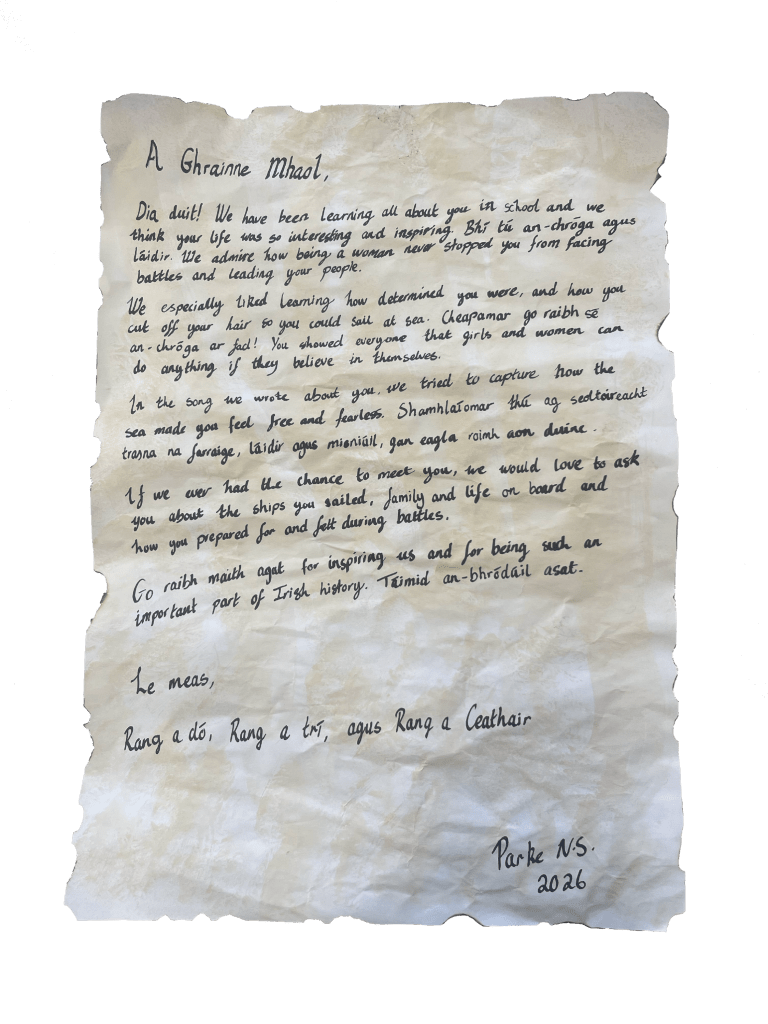
Text of the letter above:
A Ghráinne Mhaol,
Dia duit ! We have been learning all about you in school and we think that your life was so interesting and inspiring. Bhí tú an-chróga agus láidir.
We admire how being a woman never stopped you from facing battles and leading your people.
We especially liked learning how determined you were, and how you cut off your hair so you could sail at sea. Cheapamar go raibh sé an-chrógach ar fad!
You showed everyone that girls and women can do anything if they believe in themselves.
In the song we wrote about you, we tried to capture how the sea made you feel free and fearless. Shamhlaíomar bhí seoltóireacht trasna na farraige, láidir agus mioniúil gan eagle roimh aon duine.
If we ever had the chance to meet you, we would love to ask you about the shipsy ou sailed, sfamily adn life on board and how you prepared for and felt during battles.
Go raibh maith agat for inspiring us and for being such an important part of Irish history. Táimid an-bhródúil asat.
Le meas,
Rang a dó, Rang a trí, agus Rang a Ceathair,
Parke N.S
2026
BALLYVARRY CENTRAL NATIONAL SCHOOL
Teacher: Diarmaid Moynihan
This song titled “Gráinne the Gael” attempts to tell a story of the life of the infamous pirate queen of Co. Mayo, evoking her resilience and fierce determination in the face of adversity while honouring her heroic spirit.
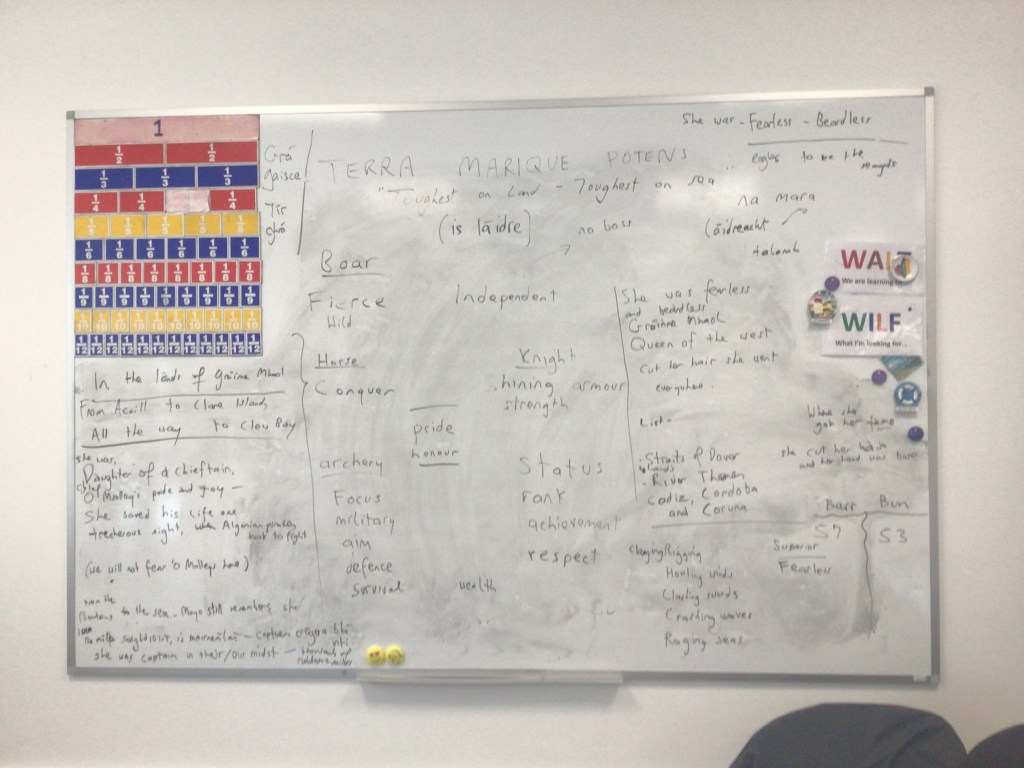
This sixth class of 26 pupils was the biggest group involved in the project with many keen musicians in the group. Teacher Diarmaid Moynihan, an accomplished musician and music teacher himself also was comfortable working as Gaeilge and this brought another dimension to the project. I began with drama, rhythm and listening games with this group using the hall and courts outside for scope and space as we explored the atmosphere and the scope of the Gráinne Mhaol story. Given that the class was older than the other groups, I felt to work on a more edgy theme, to engage with the energy and fierce qualities of this heroic woman and the challenges that she overcome during her life. The rhythm and chord pattern aims to evoke the challenge of navigating a ship through tumultuous waves. The song also includes repetition of the ‘O Malley clan motto ‘toughest on land toughest on sea’ immortalised as ‘Terra Marque Potens’ on the clan’s crest.
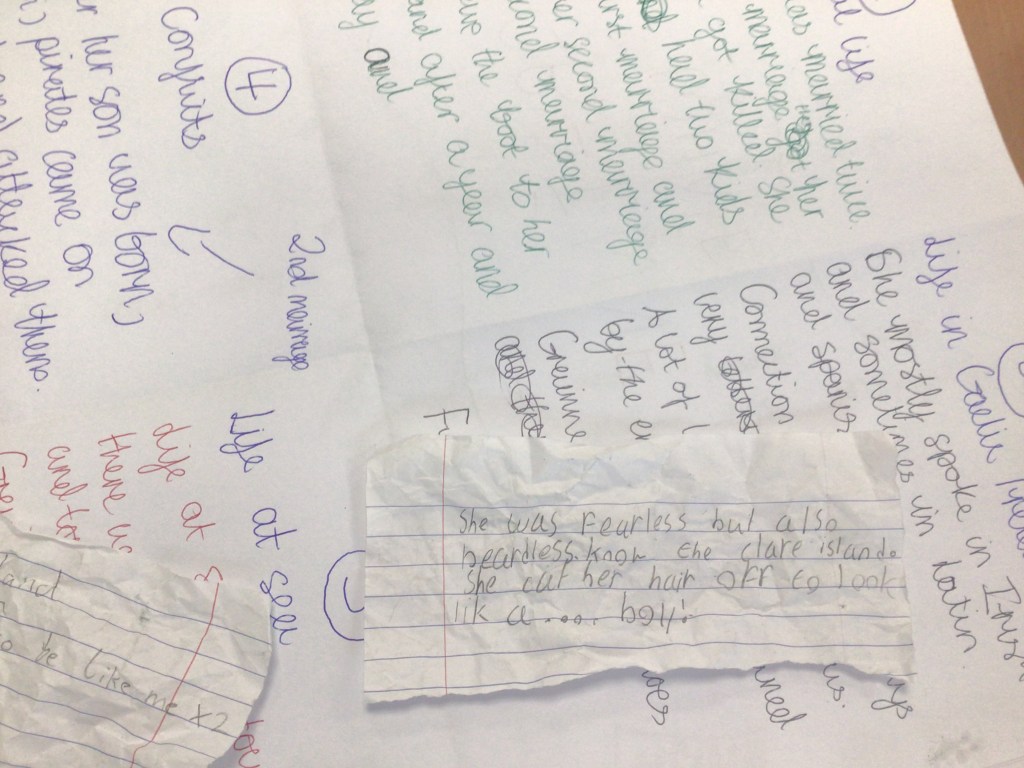
To compose the lyrics the class worked in small groups given short periods of time to focus on key themes and come up with words and insights. We also had one session where I would work with smaller groups to develop the song and lyrics while the rest of the class worked on the large scale paintings and drawings.
Finally, once I had the various contributions including the classic line ‘she was beardless and fearless’ – I worked on putting the elements together into a coherent narrative. “She lived half her life on a boat and she was the ‘GOAT’” was a fully formed sentence that I paired with “She was more beautiful than a rose, but way tougher than her bros” – each contributed by different students. In exploring inspiration and lyrics for the song, we also discussed the symbolsism of the ‘O Malley crest – the ships and the boar at the centre. The latin words “Terra Marique Potens” also comes from this.
In putting together the verses for the song using the words contributed by the class, I also felt to include some Irish language and so, the brief “Cé Hí?” choral section evolved. Using the Irish language in this way seems to resonate well with the title that the class chose for the song ‘Gráinne the Gael’. Irish would have been Gráinne Mhaol’s first language after all. Even though she also may have spoken some English, records indicate that when she met the English monarch, queen Elizabeth, Latin was their chosen language.
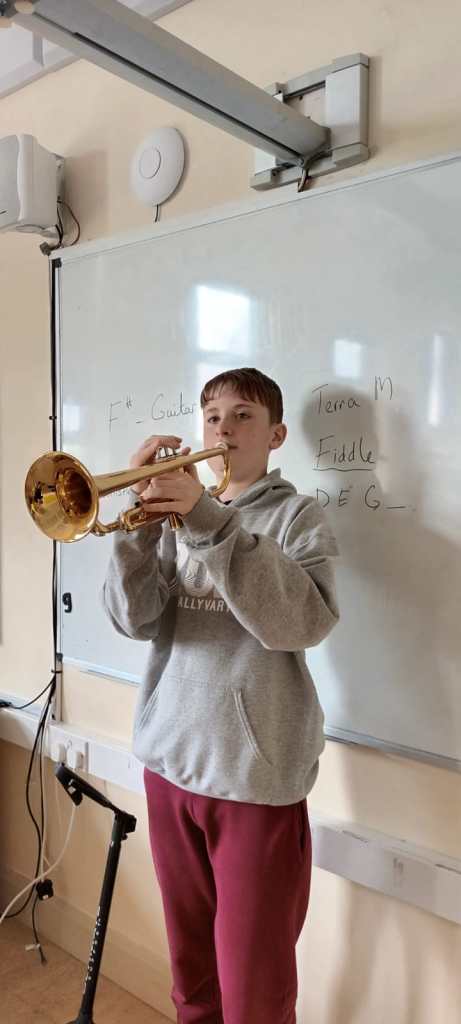
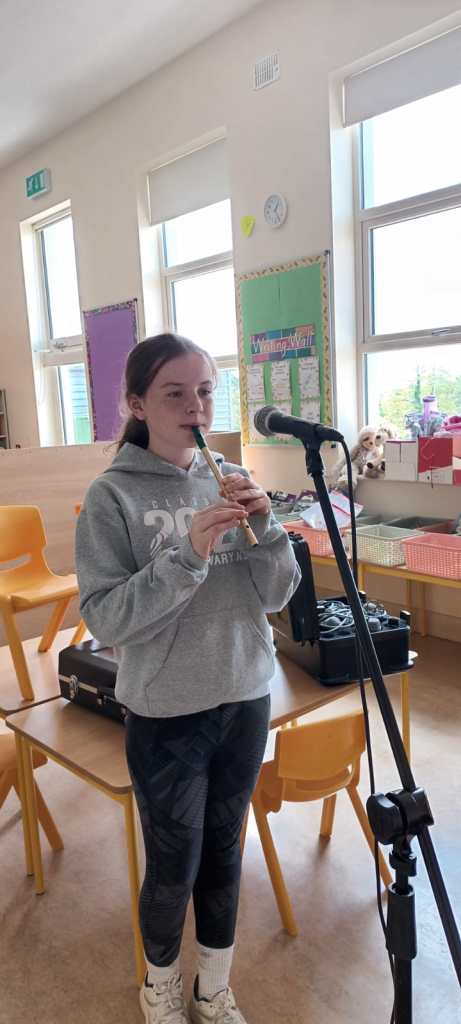
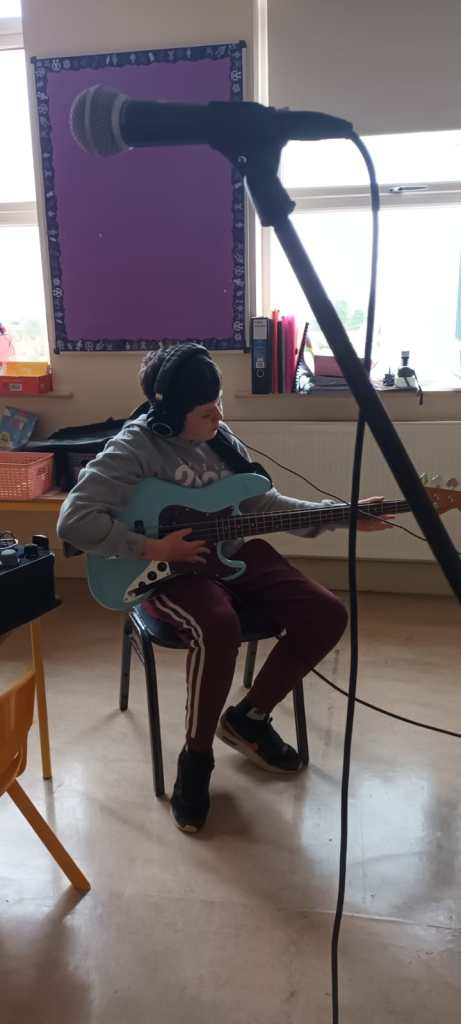
Following a recording of the main sections of the song, musicians on trumpet, bass guitar, fiddle and tin whistle, worked together with their teacher to develop instrumental pieces that could be added to the final song. These instrumental sections were recorded separately and later I added them to the mix that you can listen to below.
The refrain of ‘toughest on land, toughest and sea, everybody wants to be like me’ was coined early in the process of writing the song. It felt like a strong call to arms and encapsulates the heroism, resilience, leadership, strength of mind and of character that was clearly shown in the story of Grace ‘O Malley.
As this class are moving on to secondary school, bracing themselves for new experiences, I hope that they can feel energised and courageous drawing on all that they have achieved through their creative engagement with the story of Grace ‘O Malley, Gráinne Mhaol.


Note:
This project was funded through the Creative Clusters Programme, an initiative of the department of Education. Creative Clusters is an initiative of the Department of Education and Youth under Creative Ireland, Creative Youth 2023-2027, led by, and in partnership, with the 21 full-time education support centres (Education Support Centres Ireland – ESCI).
Creative Clusters is a key initiative of the Creative Youth Plan 2023-2027 which focuses ‘on providing young people with opportunities to learn and develop the key skills and competencies of collaboration, critical thinking, problem-solving and innovation. These skills are encouraged through engagement with creativity and through access to a creative education in a range of formal and informal
 Soul Compass